Employee self-onboarding
A newly invited employee completes their own details in four steps: personal details, bank account, tax declaration and super fund. The invitation is the employee's sign-in, so no Payroo account is needed. When the fourth step saves, the employee becomes active.
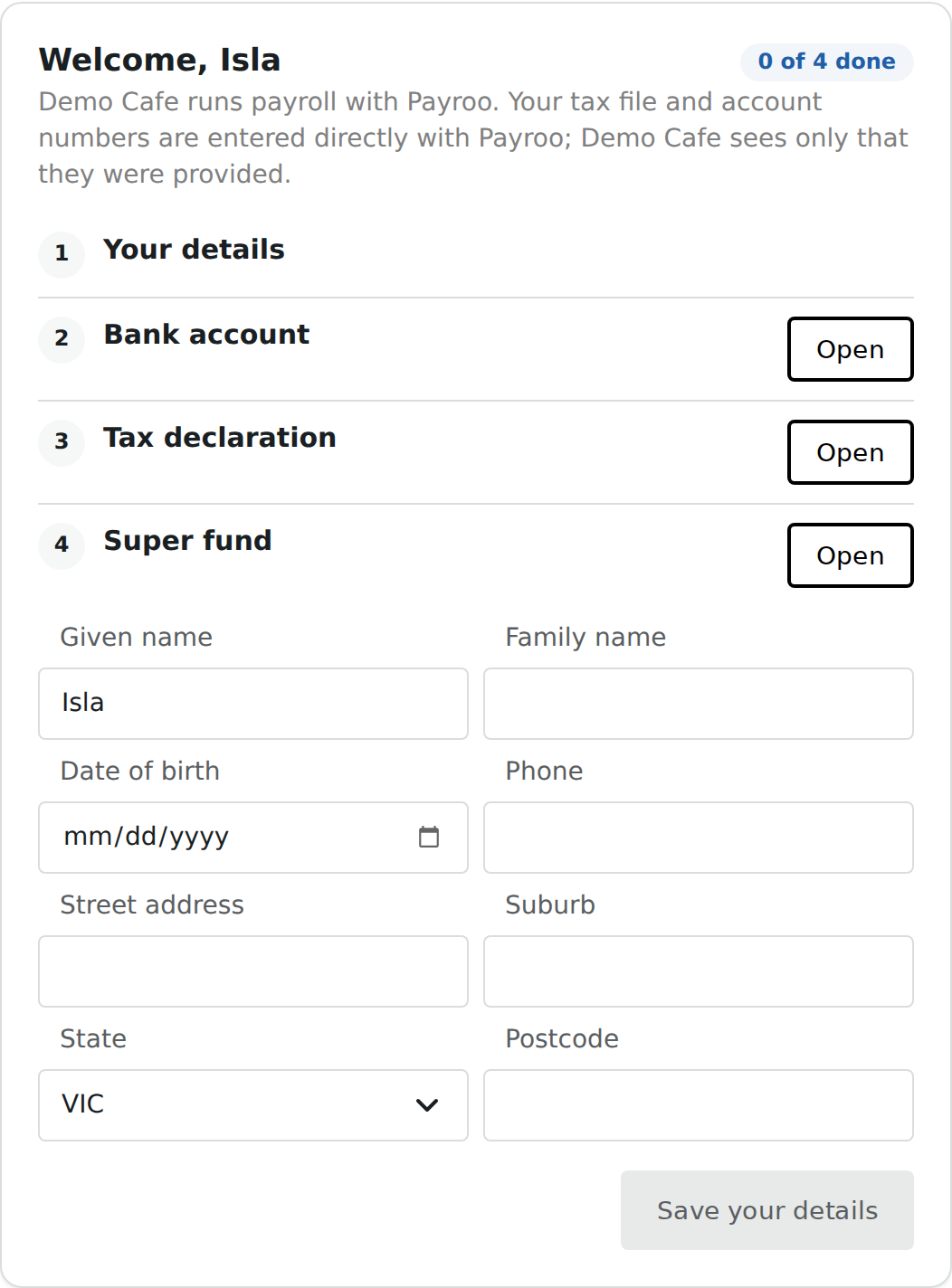
| Session | employee, from the invitation (POST /invitations/{token}/session); self:onboarding |
| Component id | employee-self-onboarding |
| React export | SelfOnboarding |
| Guide | Employees, section Self-onboarding |
Try it live on synthetic data, natively and in Payroo's frame: Employee self-onboarding (invite an employee in the step before, then open the link).
Mount it
You do not mount it in the usual case: the invitation link opens Payroo's own landing page, on Payroo's origin, which hosts this component. Mount SelfOnboarding yourself only when your product already signs the employee in and you exchange the invitation token for the session on your server.
<SelfOnboarding onCompleted={() => router.push('/welcome')} />
Props
| Prop | Meaning |
|---|---|
onCompleted() |
all four steps are saved |
Events
| Event | When |
|---|---|
employee.onboarding.step_completed |
a step saved (payload stepId) |
employee.onboarding.completed |
the fourth step saved; once per employee |
The same employee.onboarding.completed arrives as a webhook at your server.
Errors it can show
| Code | Meaning | Next action |
|---|---|---|
invitation_invalid |
the link is unknown, expired or already used | the employer re-sends the invitation |
invalid_handle |
a secure value was spent or expired | type it again |
validation_failed |
a field is wrong; the form marks which | fix the field |